The making of linen · Leeweaving
From yarn to fabric.
Six connected stages, all under one roof. Follow a single thread from the dye vat to the packed roll — and see what goes into every metre we make.
Weaving in Surat since 2012
Behind the fabric
Every stage leaves its mark on the cloth.
Linen fabric is not made in a single step.
From yarn dyeing and warping to weaving, mending, finishing and final inspection, each stage shapes the colour, structure, feel and consistency of what you finally receive.
Because every stage happens in our own unit, we can see — and control — how one step affects the next.
- Prepare
- Weave
- Refine
- Inspect
- Years of weaving
- Looms in operation
- Metres per month
- People on our team
The fabric journey
Six stages, one continuous thread.
Tap a stage for the short version — or scroll on for the full story of each one.
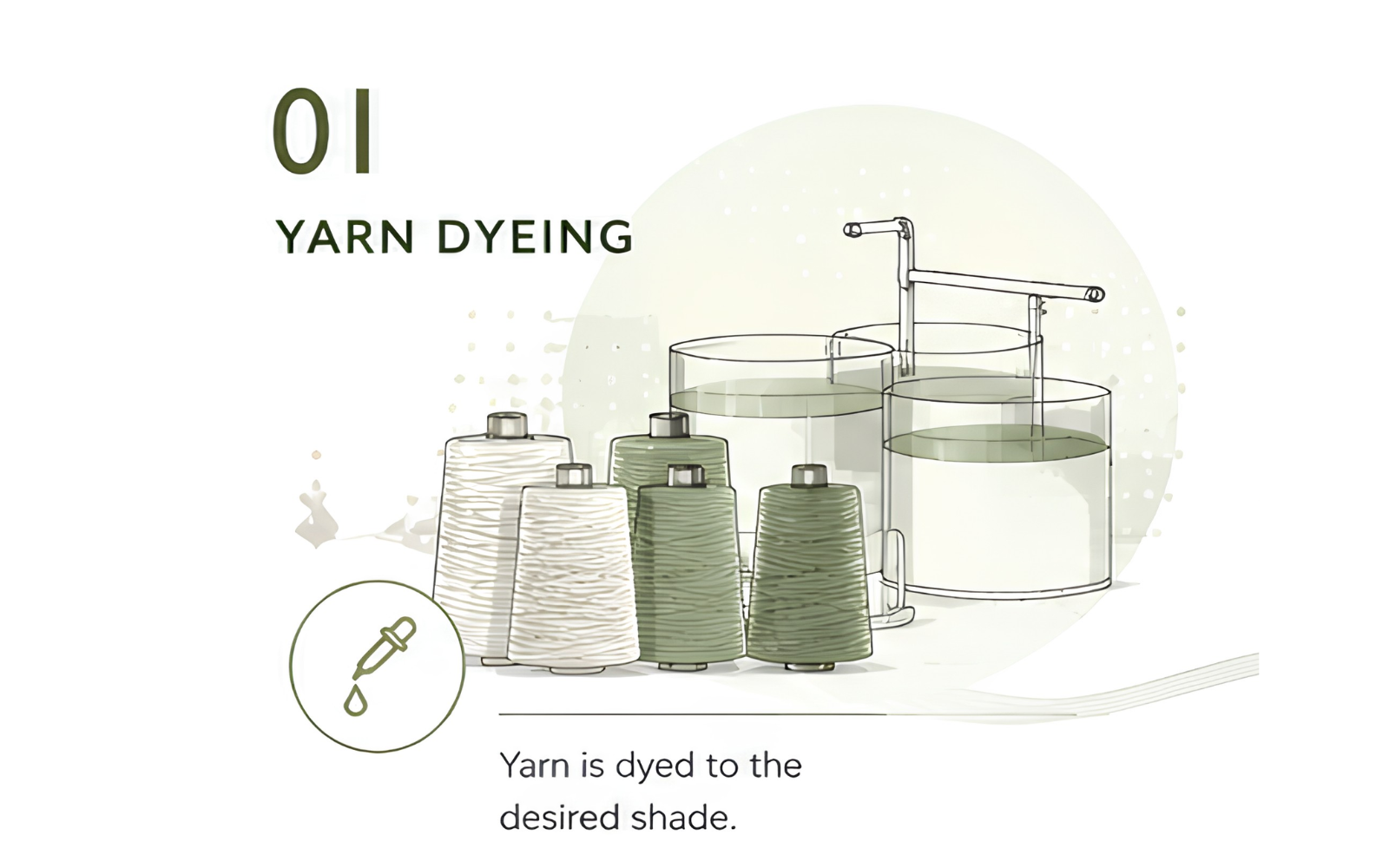
Yarn dyeing
Colour becomes part of the yarn before weaving begins, so the shade runs right through the cloth.
Read the full stageStage 01 of 06
Yarn dyeing
Colour starts in the yarn.
The process begins with the yarn. Dyeing gives it the required colour before it moves into preparation and weaving.
Because the colour is in the yarn itself, careful shade development and consistency here decide the colour of the finished fabric.
- Purpose
- Colour development
- Focus
- Shade consistency
- Output
- Dyed yarn, ready for warping
Stage 02 of 06
Warping
Order before the weave.
Warping arranges the dyed yarn side by side and winds it onto the beam as the warp — the lengthwise foundation of the fabric.
Even arrangement and tension here keep weaving smooth and the finished cloth uniform.
- Purpose
- Prepare the warp
- Focus
- Arrangement & tension
- Output
- Beam ready for the loom
Stage 03 of 06
Weaving
Where yarn becomes fabric.
On the loom, the warp is lifted and lowered while the weft is passed across it — over one, under the next — row after row.
The way warp and weft interlace sets much of the fabric’s structure, texture and visual character.
- Purpose
- Form the fabric
- Focus
- Structure & texture
- Output
- Woven fabric
0 / 12 picks · plain weave
Stage 04 of 06
Mending
Looking closer.
Once woven, the fabric is examined for visible defects or irregularities, and identified faults are carefully corrected before it moves on.
It takes patience and a trained eye — because small details matter once fabric becomes part of a finished product.
- Purpose
- Correct visible faults
- Focus
- Detail & patience
- Output
- Cleaner fabric for finishing
Stage 05 of 06
Processing & finishing
The fabric finds its character.
After weaving and mending, the fabric is processed and finished according to its specification and end use.
This stage shapes how the fabric looks and feels. The exact treatment depends on the requirement and the intended application.
- Handle
- How it feels
- Appearance
- Surface & look
- Character
- Drape & texture
- Finish
- Matched to end use
Stage 06 of 06
Final inspection & packaging
Ready for its next journey.
Before it leaves us, the finished fabric is checked against the required specification.
It is then rolled and packed so it travels safely into the next stage of your production.
- Inspect
- Final fabric review
- Prepare
- Roll & pack
- Dispatch
- Into your production chain
In one line
Six stages. One fabric.
Each stage hands the fabric to the next. Together they decide the colour, structure, feel and consistency of every roll we dispatch.
Experience, applied
Experience lives between the steps.
Knowing the order of operations is the easy part.
Real manufacturing experience is knowing what can affect the fabric at each stage — and how a decision in one step shows up in the next.
Weaving since 2012, we treat the final fabric as the sum of every choice made along the way.
Built for business
Your fabric becomes your product.
Our process doesn’t end when the roll is packed — it continues in your garment, collection or product. Tell us what you’re making and we’ll talk you through how we’d weave it.
WhatsApp: +91 95775 77565